
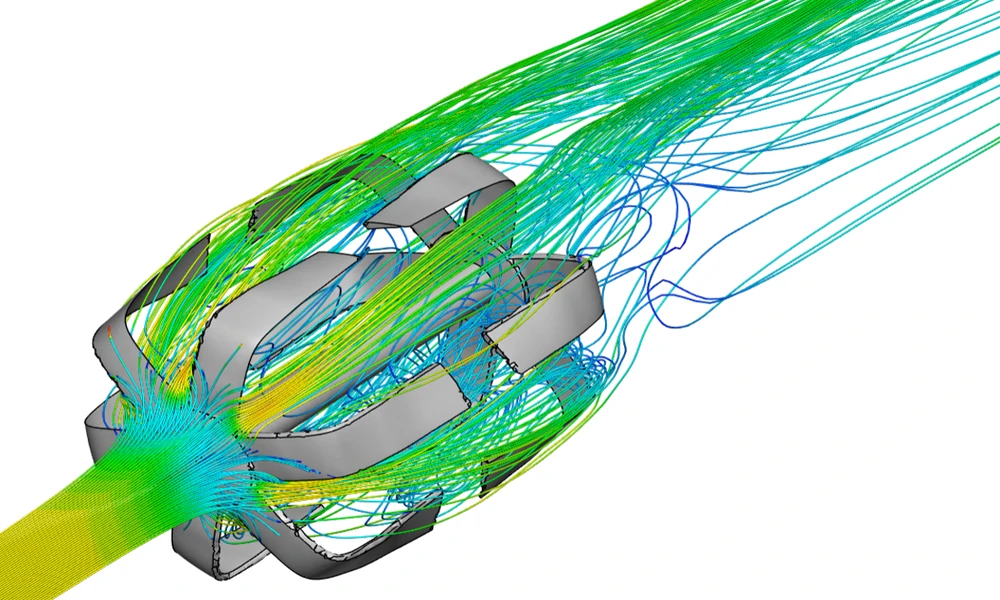
Engineers often need to understand how air, water, gases, or other fluids will behave inside a system before that system is physically built. The problem is that fluid behavior can be difficult to predict from drawings and calculations alone.
Computational fluid dynamics, commonly known as CFD, provides a way to investigate these behaviors digitally.
Rather than waiting for a physical prototype to reveal a problem, engineers can use computational fluid dynamics CFD software to create simulations and examine how fluid movement changes under different conditions.
What Cfd Actually Simulates
At its core, CFD uses numerical methods to approximate the behavior of fluids.
A model can incorporate variables such as velocity, pressure, temperature, density, turbulence, and boundary conditions. The software then divides the modeled space into a computational mesh and solves the relevant equations across that domain.
The result is not simply an animated picture of moving air.
A properly constructed simulation can provide engineers with quantitative information about what is happening inside a system and how different design choices affect its performance.
Hvac And Building Applications
One important application is building ventilation.
A conventional floor plan may show where air-conditioning units and vents are located, but it does not necessarily reveal whether conditioned air will reach every occupied area effectively.
CFD can help investigate:
• Air distribution in large rooms
• Temperature variations
• Ventilation effectiveness
• Potential stagnant zones
• Natural ventilation
• Smoke movement
• Indoor thermal comfort
• Interaction between mechanical and natural airflow
This can be particularly useful in spaces with complicated geometry, high ceilings, large occupancy levels, or unusual ventilation requirements.
Industrial Engineering
CFD is also widely applicable beyond buildings.
Manufacturers may use simulations to investigate airflow around machinery, cooling of electronic components, combustion processes, pressure losses, or fluid behavior inside pipes and ducts.
Consider an enclosure containing heat-generating equipment. Simply increasing the fan size may not solve the problem if hot air remains trapped in particular areas.
A simulation can help identify where heat accumulates and whether changes to vent placement, fan direction, internal geometry, or cooling strategy could improve performance.
Why Mesh Quality Matters
One of the technical considerations often overlooked by newcomers is the computational mesh.
The geometry being analyzed is divided into many smaller elements. The equations are then solved throughout these elements.
A finer mesh can capture certain geometric and flow details more accurately, but it also increases computational requirements. An excessively coarse mesh may fail to represent important features of the flow.
Engineers therefore need to balance accuracy and computational cost.
Mesh independence studies can help determine whether further refinement materially changes the results. This is one reason CFD should be treated as an engineering analysis rather than simply pressing a “simulate” button.
Cfd Results Still Require Engineering Judgment
A visually impressive CFD animation does not automatically mean the underlying analysis is accurate.
Results depend on assumptions, boundary conditions, material properties, turbulence models, mesh quality, and numerical settings. If the input conditions do not represent the real system, the simulation may produce a technically precise answer to the wrong question.
Validation is therefore important when practical testing or reliable reference data are available.
The strongest engineering workflow often combines simulation with calculations, experimental measurements, and professional judgment.
Choosing Cfd Software
When selecting computational fluid dynamics CFD software, engineers should consider the type of problem they need to solve rather than choosing a platform based solely on its feature list.
Important considerations can include:
• Supported physics and simulation models
• CAD and geometry compatibility
• Meshing capabilities
• Solver performance
• Automation and scripting options
• Visualization tools
• Computing requirements
• Documentation and technical support
• Validation and verification capabilities
Different engineering teams may prioritize different features depending on whether they work primarily with HVAC, automotive aerodynamics, electronics cooling, industrial processes, or another application.
Simulation As A Design Tool
The greatest value of CFD is not the colorful visualization at the end of a simulation. It is the ability to ask “what if?” before making an expensive physical change.
What if a vent is moved?
What if a duct is resized?
What if the fan speed changes?
What if a heat source is relocated?
By comparing these scenarios digitally, engineers can identify promising designs earlier in the development process.
CFD cannot eliminate uncertainty, but when properly constructed and interpreted, it can significantly improve the information available when engineering decisions are made.

Comments are closed.